Our History
One building.
A century of care.
Hospital. Welfare home. Day care. Neighborhood center. Few buildings in Springfield, Missouri have carried so much of the Black community's history under a single roof.
1900
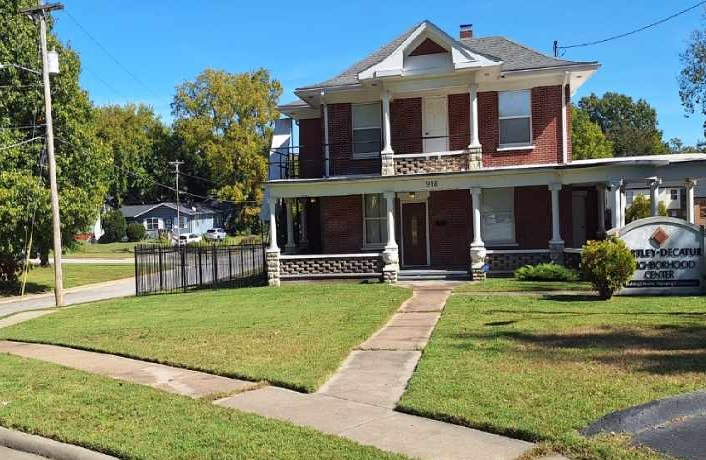
A residence is built
A two-story brick home rises on what was then 914 E. Calhoun Street, in the heart of one of Springfield's Black neighborhoods. The 1919 city directory still lists it as the residence of William Hancock.
1920
The Springfield Clinic Hospital
The board of directors of the Springfield Colored Hospital Association purchases the building. By 1921 it is listed in the city directory as the Springfield Negro Clinic — one of the few hospitals open to Black patients in the segregated city.
1921
A clinic for Negro babies
A May 1921 newspaper notice invites Black mothers to bring their children for free examinations: "The children will be examined by competent physicians who also will make recommendations for their care and treatment."
1929
Dr. W. E. Hunter, city physician
Flyers from the era list "For Emergency, Call Negro Clinic — Dr. W. E. Hunter, city physician." Hunter, a Tennessee-born Black doctor licensed in Missouri in 1925, served the community from his Boonville Avenue office and the Calhoun Street clinic.
1941
The Springfield Colored Welfare Home
The association renames itself, but its purpose remains: to care for the "sick, infirm or injured colored people of the city of Springfield."
1961
A broader mission
Board members shift the home's focus from a hospital to a more general charitable mission, encouraging "improvement of any and all benevolent and charitable activities of colored people."
1972
Kiddie Kove Day Care opens
Sisters Roberta Bartley and Olive Decatur — both teachers at the segregated Lincoln School and, after 1954, in Springfield Public Schools — open a day care in the building, primarily serving the young Black mothers they had once taught.
1992
The sisters pass on their legacy
Roberta and Olive both die in 1992. Kiddie Kove continues for several more years before closing around 1999. The building begins to fall into disrepair.
2002
A community refuses to lose it
Concerned neighbors come together to save the property. Windows broken, walls tagged, toys still scattered from Kiddie Kove — "It was pretty bad, and eventually got even worse," recalled board chairman Mark Dixon.
2003
Bartley-Decatur Neighborhood Center, Inc. is chartered
Neighbors and supporters formally incorporate the Bartley-Decatur Neighborhood Center, Inc. as a nonprofit organization, named in honor of the sisters whose Kiddie Kove Day Care had served the community for nearly three decades.
2011
Restored and reopened
With a $500,000 federal grant secured with help from then-Senator Kit Bond, the Bartley-Decatur Neighborhood Center, Inc. reopens the building as a community hub — meeting room, conference room, public computers, and a place to gather.
2021
The community answers, again
After the building was vandalized with racial slurs, hundreds of Springfieldians showed up with paint, donations, and cleaning supplies. The Center emerged stronger and more loved than before.
Today
Together we can
More than 125 years after its first brick was laid, 918 E. Calhoun still stands — a living archive of Black Springfield, and an open door for the neighborhood it has always served.
"Back when the community was segregated, it wasn't a matter of choice but of circumstance that folks had to depend on each other more — African-Americans in particular."— Mark Dixon, Board President